Blog · Longevity by Design
Longevity by Design: 16 Evidence-Based Principles
Published: July 20, 2026 · Updated: July 20, 2026
By Sabina Malikova, Sabina Malikova Design Office.
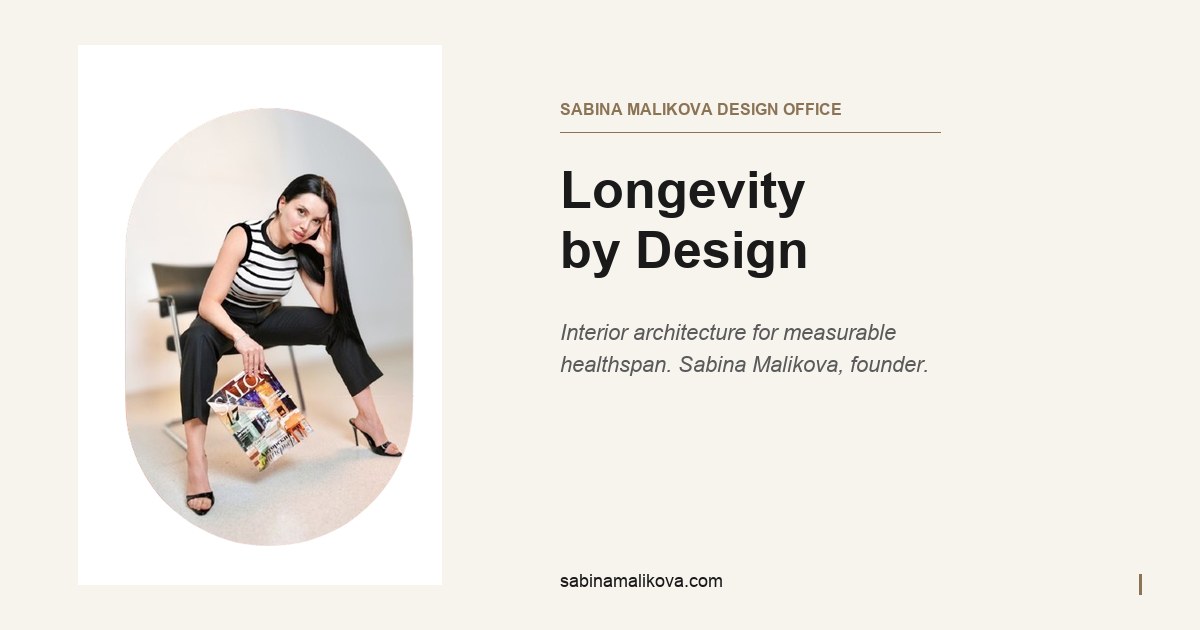
Longevity by Design is a measurable methodology for healthy interiors. This article sets out its sixteen evidence-based principles. Each principle cites a primary source. The framing rests on two established figures. The WHO links nearly one in four deaths to modifiable environmental factors (WHO, 2016). People spend about 90% of their hours indoors (Klepeis, 2001). The interior is therefore the most controllable health intervention available. The principles are organised under four measurable pillars. CLCI covers circadian light. Daytime lighting runs
at 4000–5000 K. Evening lighting drops to 2200–2700 K. A randomized trial improved sleep-quality scores by roughly a third (Figueiro, 2020). BCS covers biophilia. Every occupied space needs at least three natural elements. Nature contact lowers cortisol by about 21% per hour (Hunter, 2019). IAQM covers indoor air. HEPA-13 filtration pairs with heat-recovery ventilation. The target holds PM2.5 below the WHO 2021 limit of 5 µg/m³. AHR covers acoustics. Continuous indoor sound stays below 55 dB. The benchmark follows the
WHO Europe 2018 noise guidelines. Together the sixteen principles turn wellness intentions into checkable numbers. Every claim traces back to a published source.
Related reading
- Longevity by Design methodology — the four measurable pillars
- CLCI — circadian lighting explained
- BCS — the biophilic connection score
- WHO Europe 2018 — environmental noise guidelines
← All articles · The Longevity by Design methodology · Contact the studio